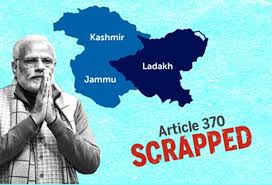
New Delhi August 11: In a pivotal moment that has captured the nation’s attention, the Supreme Court’s hearing on Article 370 has taken a significant turn with Chief Justice Chandrachud’s bold statement. During the proceedings, Chief Justice Chandrachud emphatically declared, “One thing is very clear that there was no conditional integration of Jammu and Kashmir with India. The integration was absolute and complete in every which way.”The courtroom was abuzz as Chief Justice Chandrachud delivered his stance on the contentious matter, shedding light on a topic that has been the center of heated debates and discussions. Article 370, which granted special autonomy to the region of Jammu and Kashmir, has long been a subject of legal and political scrutiny.Chief Justice Chandrachud’s assertion that the integration of Jammu and Kashmir was absolute and unconditional is poised to influence the ongoing proceedings and potentially impact the final outcome. His clear stand challenges the very foundation upon which arguments for and against Article 370 have rested.”While the integration was unambiguous, the limited question that remains is whether Parliament possessed the authority to exercise the power in this context,” Chief Justice Chandrachud continued, emphasizing the nuanced nature of the debate. His remarks underscored the need for a comprehensive examination of the legal and constitutional aspects surrounding Article 370.As legal experts and constitutional scholars continue to analyze the implications of Chief Justice Chandrachud’s statements, the nation eagerly awaits further developments in this historic hearing. The outcome of the proceedings is expected to shape the future course of the relationship between the Indian government and the erstwhile state of Jammu and Kashmir.The courtroom drama surrounding Article 370 remains far from over, and with Chief Justice Chandrachud’s remarks, the trajectory of this pivotal
Article 370 Hearing “Integration of J&K with India was Absolute,” Says Chief Justice