

Syed Jahanzeb
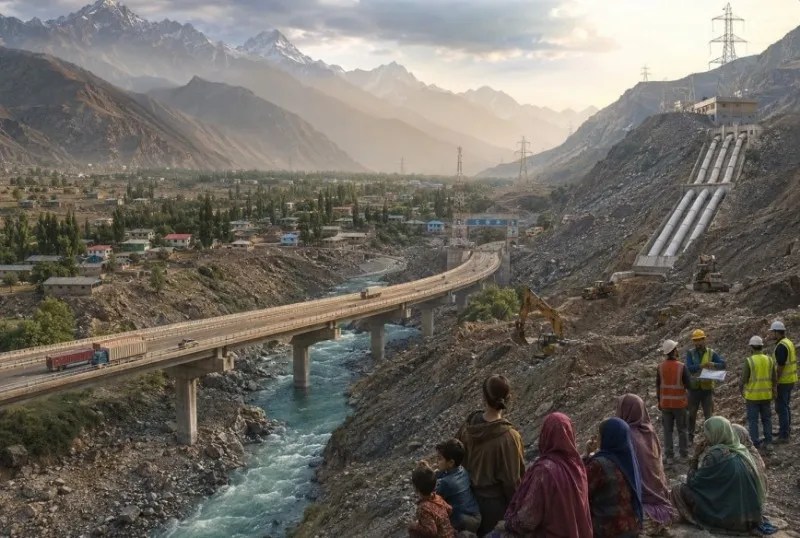
The China-Pakistan Economic Corridor (CPEC) has been presented as a transformative economic project that will connect Pakistan with China and open new avenues of trade, investment and development. Gilgit-Baltistan occupies an important geographical position in this framework because the Karakoram Highway passes through the region and connects Pakistan with China through the Khunjerab Pass. Yet behind the language of connectivity and economic growth lies a more difficult question: who actually owns, controls and benefits from this development? For the people of Gilgit-Baltistan, the issue is not necessarily opposition to roads, telecommunications, energy projects or economic activity. The deeper concern is that development is being planned largely through institutions outside the region, while local communities often have limited influence over decisions concerning their land, resources and economic future.
There have undoubtedly been tangible CPEC-related developments in Gilgit-Baltistan. The 820-kilometre cross-border optical fibre project, for example, was completed in 2018 and passes through Gilgit-Baltistan before connecting onward to Mansehra, Muzaffarabad, Islamabad and Rawalpindi. The project was officially described as intended to improve telecommunications, tourism and trading opportunities in the northern areas. Similarly, the CPEC framework includes infrastructure and energy proposals in Gilgit-Baltistan. The official CPEC project database lists the 80 MW Phandar Hydropower Station and the 100 MW Gilgit KIU Hydropower Project, although both are currently described as being under review by experts from Pakistan and China. The proposed realignment of the Thakot-Raikot section of the Karakoram Highway also forms part of the corridor’s infrastructure plans.
These projects demonstrate the strategic importance of the region. But infrastructure alone cannot be equated with inclusive development. The central problem is the question of local ownership. Gilgit-Baltistan has a complicated history of land administration, particularly concerning communal and customary lands. Recent academic research has documented how the classification of certain lands as Khalisa Sarkar has generated long-running disputes between state institutions and local communities. The research also argues that CPEC-related infrastructure, together with tourism and mineral development, has intensified pressure on land and transformed the region into an increasingly valuable resource frontier. This is where the development model becomes controversial. If land is taken or allocated for a major project without meaningful consultation with communities that have historically used or claimed that land, the project may be economically significant but socially divisive. Development cannot be sustainable when the people living on the land feel that they have become spectators in decisions concerning their own future.
The controversy surrounding the proposed Moqpondass Special Economic Zone illustrates this challenge. The CPEC Secretariat identifies the Moqpondass SEZ in Gilgit-Baltistan as a project at the feasibility stage, while research on land politics in the region has documented disputes over the allocation of contested Khalisa lands for the proposed zone.
There is also the question of employment and economic participation. A road passing through a region does not automatically create prosperity for its residents. Nor does a power project necessarily improve the lives of communities if electricity generated from their resources is primarily integrated into wider national systems while local energy shortages continue. The real test should be whether local people obtain skilled employment, business opportunities, training, ownership stakes and a meaningful share in the revenues generated from projects located on their land.
This concern has also appeared in human rights reporting. A fact-finding report by the Human Rights Commission of Pakistan recorded complaints from residents of Gilgit-Baltistan that local communities were being excluded from development projects, including CPEC-related initiatives, and that senior positions were frequently occupied by non-residents while locals were left with lower-level employment.
The issue therefore goes beyond China. It is primarily about the way Pakistan’s development policy is implemented in Gilgit-Baltistan. China may provide investment, technology and expertise, but responsibility for ensuring transparency, consultation, compensation and local participation ultimately rests with the authorities administering the region. Pakistan’s own official narrative acknowledges that CPEC is intended to bring less-developed areas, including Gilgit-Baltistan, into the country’s wider development framework. That objective can only be achieved if development is measured not simply by kilometres of roads constructed or megawatts of electricity planned, but by improvements in the lives and economic position of local communities.
Gilgit-Baltistan needs development, but it also needs a voice in determining what that development should look like. Local communities should have a meaningful role in land decisions, environmental assessments, project planning and monitoring. Compensation for acquired land must be transparent and fair, while customary and communal land rights should not be brushed aside merely because they do not fit neatly into conventional property records. CPEC could potentially transform Gilgit-Baltistan’s connectivity and economic prospects. But connectivity without participation can deepen alienation, and investment without local ownership can create resentment rather than prosperity. The region should not merely be treated as a geographical passage between China and Pakistan.
For CPEC to become genuinely beneficial to Gilgit-Baltistan, its people must move from being subjects of development to partners in it. Roads, fibre-optic cables, hydropower stations and economic zones may create physical infrastructure, but genuine development begins when the people whose land and resources make these projects possible have a decisive stake in their benefits. Without that principle, CPEC risks becoming a story of development in Gilgit-Baltistan rather than development with Gilgit-Baltistan.


