


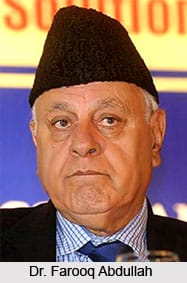
Dr Farooq Abdullah Hits Out At So-Called Mukhbirs
Kashmir’s Leaders Must Decide Whether Their Actions Contribute To Unity Or Division
Sheikh Sameer
The history of Kashmir since 1990 is a grim tale of violence, marked by long dark years of killings, unrest, and political turmoil. Among the many strategies employed, the term “Mukbir,” meaning “informer,” has been wielded as a lethal weapon.
This word was utilized by Pakistan to target individuals deemed to be collaborating with Indian security forces. This label has not only claimed hundreds of lives but has also become a dark emblem of mistrust, fear, and manipulation within the region. This article explores the genesis, evolution, and implications of the Mukhbir phenomenon, culminating in its recent utilization by significant political figures.
The Emergence of the Mukhbir Label
The 1990s were a tumultuous period for Kashmir, marked by insurgency and separatist movements. It was within this atmosphere that the term Mukbir was introduced as a tool for militants to eliminate individuals they perceived as informers. By labelling these individuals as Mukbirs, they became targets for execution, often with tragic consequences. This tactic played into the climate of fear and instability. All those who did not agree with the Pakistan-Hurriyat-Jamaat e Islami version were usually labeled as mukhbirs or informants, and killed.
Kashmiri Pandits and the Mukhbir Label
In its early years, the Mukhbir label was particularly used against the Kashmiri Pandit community and those expressing pro-India sentiments. This led to a series of targeted killings and persecution, which eventually contributed to the exodus of the Kashmiri Pandit population. The systematic use of the Mukhbir label against this minority group not only resulted in loss of life but also left a deep scar on the social fabric of Kashmir, further polarizing communities and deepening the divide.
Expansion of the Mukhbir Narrative
The Mukhbir label’s significance expanded beyond the realm of mere informant accusations. It began to be associated with individuals who held ideas aligning with the Indian state, or anyone who exhibited nationalist sentiments.
This broadening of scope was marked by the introduction of the term “collaborator,” which further complicated the narrative. The brand of collaborator not only targeted those with direct information-sharing but anyone perceived to be supportive of India’s presence in the region.
Shift in Political Rhetoric: Dr. Farooq Abdullah’s Statements
A significant recent development that has raised eyebrows is the utilization of the Mukhbir label by Dr. Farooq Abdullah, a prominent political leader and the patron of the National Conference. His reference to Mukbirs has caused concern due to its historical implications and its association with past targeted killings, including those of his own party members. This shift in rhetoric raises questions about the motives behind such usage and its potential consequences for the political landscape of Kashmir.
Unpacking Dr. Abdullah’s Stance
Dr. Farooq Abdullah’s use of the Mukhbir label presents a paradoxical situation, given his stature and political legacy. This shift in rhetoric from a nationalist leader to echoing divisive terminology associated with separatist groups invites scrutiny. It has the potential to lend credence to a narrative that has long fueled instability in the region. The implications of such a change are complex and demand an assessment of its effect on Dr. Abdullah’s identity, the party’s legacy, and the overall pursuit of a peaceful and united Kashmir.
Implications on the Narrative and Political Landscape
The Mukhbir phenomenon’s evolution from a lethal tool wielded by terrorists to a term adopted by political figures underscores the power of language in shaping narratives. Dr. Abdullah’s use of the term reveals the complexities of the political landscape and the fluidity of allegiances. It also demonstrates the thin line between nationalistic discourse and that which aligns with secessionist groups, blurring the distinctions between ideologies and further muddying the waters.
A Precarious Crossroads: Nationalism vs. Separatism
Dr. Abdullah’s choice to incorporate the Mukhbir label into his rhetoric begs questions about his political trajectory and aspirations. His actions reflect the ongoing struggle between nationalism and separatism within the region. This shift challenges the traditional understanding of his political identity and raises concerns about the potential impact on the region’s already delicate balance.
Future Prospects: Unity or Division?
The present-day implications of Dr. Abdullah’s rhetoric extend beyond his personal statements. They touch upon the broader Kashmiri society and its aspirations for stability, peace, and progress. The region stands at a crossroads, where leaders must decide whether their actions contribute to unity or further division. Dr. Abdullah’s choice of terminology and the narrative he aligns with will undoubtedly influence the path Kashmir takes in the years to come.
The Mukhbir phenomenon in Kashmir, which originated as a lethal label used by militants, has taken on new dimensions through its adoption by political figures. The historical trajectory of this label reflects the evolution of the conflict itself, highlighting the power of language in shaping narratives and political landscapes.
Dr. Farooq Abdullah’s recent use of the Mukhbir label has thrust this issue into the spotlight, prompting reflections on his political identity and the broader implications for the region. As Kashmir navigates its complex landscape, it is crucial to assess the impact of these linguistic shifts on the pursuit of peace, unity, and a stable future for all its people.


